
English Grammar
English Sentence Structure: Subject, Verb, and Object Explained in Hindi
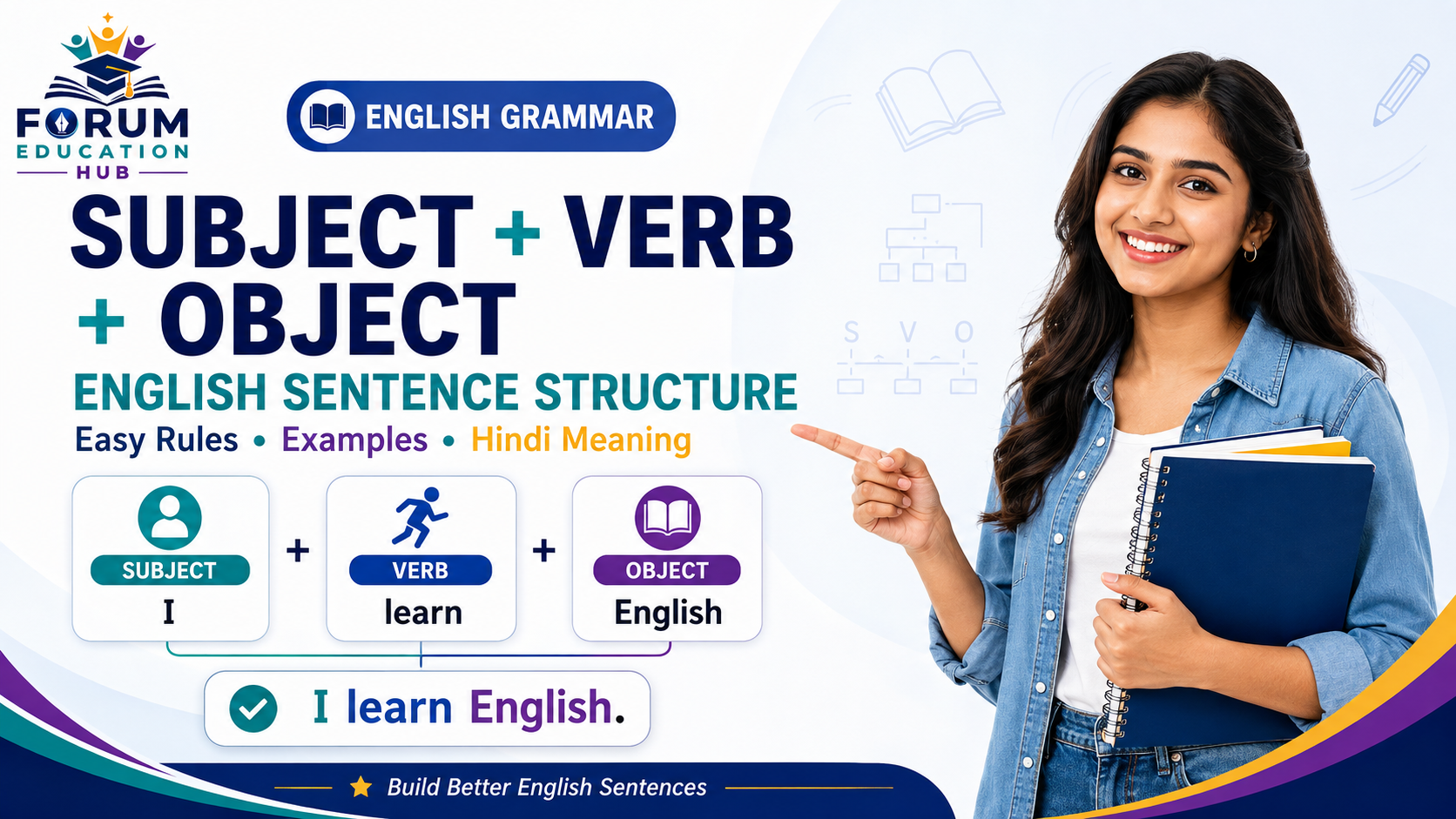
Learn English sentence structure with simple explanations of subjects, verbs, and objects, Hindi meanings, everyday examples, common mistakes, and exercises.
Do you know individual English words but struggle to arrange them into complete sentences?
For example, you may understand:
- I
- English
- Learn
But which arrangement is correct?
❌ I English learn.
✅ I learn English.
The difference is sentence structure.
Many basic English sentences follow this pattern:
Subject + Verb + Object
Understanding this pattern helps you speak clearly, write correctly, and communicate confidently.
In this guide, you will learn what a subject, verb, and object are, how to identify them, and how to create practical English sentences with Hindi explanations.
What Is an English Sentence?
A sentence is a group of words that expresses a complete idea.
Hindi meaning: Sentence शब्दों का ऐसा समूह है जो पूरा अर्थ व्यक्त करता है।
Examples:
I study English.
मैं अंग्रेज़ी पढ़ता हूँ।
She drinks water.
वह पानी पीती है।
They play cricket.
वे क्रिकेट खेलते हैं।
Each sentence communicates a complete message.
However, correct sentence formation depends on placing words in the right order.
What Is Subject + Verb + Object?
Many everyday English sentences follow this structure:
Subject + Verb + Object
This is also called the SVO pattern.
Example
I learn English.
- Subject: I
- Verb: learn
- Object: English
Hindi meaning:
मैं अंग्रेज़ी सीखता हूँ।
The subject performs the action, the verb describes the action, and the object receives the action.
However, remember that not every English sentence needs an object. Some sentences use other patterns, which we will also explain.
What Is a Subject?
The subject tells us who or what performs the action.
Hindi meaning: Subject वह व्यक्ति, वस्तु या चीज़ है जिसके बारे में वाक्य में बताया जाता है या जो कार्य करती है।
Ask:
Who is doing the action?
Examples
Rahul studies English.
- Who studies English?
- Rahul.
Therefore, Rahul is the subject.
She reads a book.
- Who reads a book?
- She.
Therefore, she is the subject.
The students practise speaking.
- Who practises speaking?
- The students.
Therefore, the students is the subject.
Common Subjects
Subjects can include:
- I
- You
- He
- She
- It
- We
- They
- A person’s name
- A group of people
- An animal
- An object
Examples:
I drink tea.
Priya attends the class.
My brother works in an office.
The dog chased the ball.
Our teacher explains grammar clearly.
Subject Pronouns and Hindi Meanings
| Subject Pronoun | Hindi Meaning | Example |
|---|---|---|
| I | मैं | I study English. |
| You | तुम / आप | You speak clearly. |
| He | वह, पुरुष | He plays cricket. |
| She | वह, महिला | She reads books. |
| It | यह / वह, वस्तु या जानवर | It looks beautiful. |
| We | हम | We practise together. |
| They | वे | They attend the class. |
Practice
Identify the subjects:
- My sister cooks dinner.
- They visit their grandparents.
- The teacher explains the lesson.
Answers:
- My sister
- They
- The teacher
What Is a Verb?
A verb shows an action, condition, or state.
Hindi meaning: Verb वह शब्द है जो किसी कार्य, अवस्था या स्थिति को व्यक्त करता है।
Ask:
What is the subject doing?
Examples
I read books.
- What do I do?
- Read.
Therefore, read is the verb.
She writes an email.
- What does she do?
- Writes.
Therefore, writes is the verb.
They play football.
- What do they do?
- Play.
Therefore, play is the verb.
Common Action Verbs
- Read — पढ़ना।
- Write — लिखना।
- Speak — बोलना।
- Learn — सीखना।
- Eat — खाना।
- Drink — पीना।
- Watch — देखना।
- Help — मदद करना।
- Call — कॉल करना।
- Visit — मिलने जाना।
Verbs That Describe a State
Some verbs describe a condition rather than an action.
Examples:
She is happy.
वह खुश है।
They are ready.
वे तैयार हैं।
I feel confident.
मैं आत्मविश्वास महसूस करता हूँ।
These sentences do not necessarily follow the subject + verb + object pattern. Some use a subject complement, which describes the subject.
What Is an Object?
The object is the person or thing that receives the action.
Hindi meaning: Object वह व्यक्ति या वस्तु है जिस पर क्रिया का प्रभाव पड़ता है।
Ask:
What or whom is the action directed toward?
Examples
I read a book.
- What do I read?
- A book.
Therefore, a book is the object.
She helps her friend.
- Whom does she help?
- Her friend.
Therefore, her friend is the object.
We study English.
- What do we study?
- English.
Therefore, English is the object.
More Examples
He drinks water.
They watch a movie.
My mother prepares breakfast.
We attend English classes.
The teacher answers our questions.
The SVO Formula Explained
Let us break down a complete sentence:
The student reads a newspaper.
Step 1: Find the Subject
Who performs the action?
The student
Step 2: Find the Verb
What action is performed?
Reads
Step 3: Find the Object
What is being read?
A newspaper
Final structure:
The student + reads + a newspaper.
Hindi:
विद्यार्थी अख़बार पढ़ता है।
Everyday Subject + Verb + Object Examples
| Subject | Verb | Object | Complete Sentence |
|---|---|---|---|
| I | drink | tea | I drink tea. |
| She | reads | books | She reads books. |
| He | plays | cricket | He plays cricket. |
| We | study | English | We study English. |
| They | watch | movies | They watch movies. |
| Rahul | writes | emails | Rahul writes emails. |
| My sister | cooks | dinner | My sister cooks dinner. |
| The teacher | explains | grammar | The teacher explains grammar. |
| Students | practise | conversations | Students practise conversations. |
| I | attend | online classes | I attend online classes. |
Notice how the order remains clear:
Who + does what + to what or whom?
Why Hindi Speakers Often Struggle with English Sentence Order
Hindi and English frequently arrange words differently.
Hindi Structure
मैं अंग्रेज़ी सीखता हूँ।
The general order is:
मैं + अंग्रेज़ी + सीखता हूँ।
That is approximately:
Subject + Object + Verb.
English Structure
I learn English.
The order is:
Subject + Verb + Object.
Common Mistake
❌ I English learn.
✅ I learn English.
Another example:
Hindi:
वह चाय पीती है।
Incorrect English:
❌ She tea drinks.
Correct English:
✅ She drinks tea.
Recognizing this difference can immediately improve your sentence formation.
Basic Sentence Pattern 1: Subject + Verb
Some verbs do not require an object.
Pattern:
Subject + Verb
Examples:
Birds fly.
पक्षी उड़ते हैं।
Babies cry.
बच्चे रोते हैं।
She smiled.
वह मुस्कुराई।
The students arrived.
विद्यार्थी पहुँचे।
He laughed.
वह हँसा।
These sentences are complete without an object.
Important Note
A sentence does not need an object to be correct.
For example:
She smiled.
This is a complete sentence.
Basic Sentence Pattern 2: Subject + Verb + Object
Use this pattern when the action affects someone or something.
Examples:
She reads a book.
I drink coffee.
They play football.
We practise English.
He answered the question.
Hindi examples:
She reads a book.
वह किताब पढ़ती है।
We practise English.
हम अंग्रेज़ी का अभ्यास करते हैं।
Basic Sentence Pattern 3: Subject + Verb + Complement
A complement describes or identifies the subject.
Pattern:
Subject + Verb + Complement
Examples:
She is happy.
He is a teacher.
They are confident.
The weather is pleasant.
My brother became a doctor.
Explanation
In the sentence:
She is happy.
- Subject: She.
- Verb: is.
- Complement: happy.
The word happy describes the subject.
It is not an object.
Hindi Examples
I am tired.
मैं थका हुआ हूँ।
She is a student.
वह एक विद्यार्थी है।
They are ready.
वे तैयार हैं।
Basic Sentence Pattern 4: Subject + Verb + Indirect Object + Direct Object
Some sentences contain two objects.
Pattern:
Subject + Verb + Indirect Object + Direct Object
Example:
The teacher gave us homework.
- Subject: The teacher.
- Verb: gave.
- Indirect object: us.
- Direct object: homework.
Hindi meaning:
शिक्षक ने हमें होमवर्क दिया।
More Examples
My mother gave me a gift.
मेरी माँ ने मुझे उपहार दिया।
She sent him a message.
उसने उसे एक संदेश भेजा।
The trainer taught us pronunciation.
प्रशिक्षक ने हमें उच्चारण सिखाया।
Alternative Structure
The teacher gave homework to us.
Both sentences communicate the same idea:
- The teacher gave us homework.
- The teacher gave homework to us.
Basic Sentence Pattern 5: Subject + Verb + Object + Place
You can expand a sentence by adding a location.
Pattern:
Subject + Verb + Object + Place
Examples:
I study English at home.
She reads books in the library.
They play cricket in the park.
We attend classes online.
He keeps his notebook on the table.
Hindi:
I study English at home.
मैं घर पर अंग्रेज़ी पढ़ता हूँ।
Basic Sentence Pattern 6: Subject + Verb + Object + Time
You can add time to make a sentence more informative.
Pattern:
Subject + Verb + Object + Time
Examples:
I practise English every day.
She attends the class at 9 PM.
They completed the assignment yesterday.
We will discuss the topic tomorrow.
He reads the newspaper every morning.
Hindi:
I practise English every day.
मैं प्रतिदिन अंग्रेज़ी का अभ्यास करता हूँ।
Basic Sentence Pattern 7: Subject + Verb + Object + Place + Time
Combine both location and time for a fuller sentence.
Example:
I practise English at home every evening.
- Subject: I.
- Verb: practise.
- Object: English.
- Place: at home.
- Time: every evening.
Hindi meaning:
मैं हर शाम घर पर अंग्रेज़ी का अभ्यास करता हूँ।
More examples:
She reads books in the library after class.
They play football in the park on Sundays.
We attend spoken English classes online at night.
He meets his friends at the café every weekend.
How to Form Positive Sentences
Positive sentences state that something happens or is true.
Present Simple Structure
Subject + Verb + Object
Examples:
I speak English.
You read books.
We practise grammar.
They attend classes.
Add S or ES for HE, SHE, and IT
With he, she, and it, many present-tense verbs take s or es.
Examples:
He speaks English.
She reads books.
It works properly.
Rahul watches television.
Common Mistakes
❌ He speak English.
✅ He speaks English.
❌ She read books.
✅ She reads books.
❌ My brother go to work.
✅ My brother goes to work.
How to Form Negative Sentences
Negative sentences tell us that something does not happen or is not true.
With I, YOU, WE, and THEY
Subject + do not + base verb + object
Examples:
I do not drink coffee.
You do not understand the question.
We do not miss our classes.
They do not watch television every day.
Short forms:
- Do not = don’t.
Example:
I don’t drink coffee.
With HE, SHE, and IT
Subject + does not + base verb + object
Examples:
He does not eat meat.
She does not miss her English class.
It does not work properly.
Short form:
- Does not = doesn’t.
Important Rule
After does not, use the base verb.
✅ She does not speak loudly.
❌ She does not speaks loudly.
✅ He does not like tea.
❌ He does not likes tea.
How to Form Questions
Yes/No Question Structure
Do/Does + Subject + Base Verb + Object?
Examples:
Do you speak English?
Do they attend classes?
Does she read books?
Does he understand the lesson?
Answer Examples
Do you practise English daily?
Yes, I do.
Does she attend the online class?
Yes, she does.
WH Question Structure
WH word + helping verb + subject + main verb?
Examples:
What do you study?
Where does she work?
When do they practise?
Why does he learn English?
Common Mistake
❌ Where she works?
✅ Where does she work?
Sentence Structure in Different Tenses
The basic relationship between subject, verb, and object remains important across tenses.
Present Simple
I study English.
मैं अंग्रेज़ी पढ़ता हूँ।
Present Continuous
I am studying English.
मैं अंग्रेज़ी पढ़ रहा हूँ।
Past Simple
I studied English yesterday.
मैंने कल अंग्रेज़ी पढ़ी।
Past Continuous
I was studying English.
मैं अंग्रेज़ी पढ़ रहा था।
Present Perfect
I have studied English.
मैं अंग्रेज़ी पढ़ चुका हूँ।
Future Simple
I will study English.
मैं अंग्रेज़ी पढ़ूँगा।
Comparison
| Tense | Example | Hindi Meaning |
|---|---|---|
| Present Simple | I study English. | मैं अंग्रेज़ी पढ़ता हूँ। |
| Present Continuous | I am studying English. | मैं अंग्रेज़ी पढ़ रहा हूँ। |
| Past Simple | I studied English. | मैंने अंग्रेज़ी पढ़ी। |
| Past Continuous | I was studying English. | मैं अंग्रेज़ी पढ़ रहा था। |
| Present Perfect | I have studied English. | मैं अंग्रेज़ी पढ़ चुका हूँ। |
| Future Simple | I will study English. | मैं अंग्रेज़ी पढ़ूँगा। |
Subject Pronouns vs. Object Pronouns
The form of a pronoun can change depending on its role.
| Subject Pronoun | Object Pronoun |
|---|---|
| I | me |
| You | you |
| He | him |
| She | her |
| It | it |
| We | us |
| They | them |
Examples
She called me.
उसने मुझे कॉल किया।
I helped him.
मैंने उसकी मदद की।
They invited us.
उन्होंने हमें आमंत्रित किया।
We met her.
हम उससे मिले।
Common Mistakes
❌ Him is my friend.
✅ He is my friend.
❌ She called I.
✅ She called me.
❌ Them invited us.
✅ They invited us.
Expanding Simple Sentences
Start with a basic sentence:
I study English.
Now gradually add useful information.
Add a Place
I study English at home.
Add a Time
I study English at home every evening.
Add a Purpose
I study English at home every evening to improve my communication.
Add a Future Goal
I study English at home every evening to improve my communication and prepare for job interviews.
This technique helps you progress from short sentences to more confident communication.
Sentence Expansion Examples
Example 1
Basic:
She reads books.
Expanded:
She reads English books in the library every afternoon.
Hindi:
वह हर दोपहर पुस्तकालय में अंग्रेज़ी की किताबें पढ़ती है।
Example 2
Basic:
We practise speaking.
Expanded:
We practise speaking with our classmates during the online session.
Hindi:
हम ऑनलाइन सत्र के दौरान अपने सहपाठियों के साथ बोलने का अभ्यास करते हैं।
Example 3
Basic:
He prepares presentations.
Expanded:
He prepares professional presentations for his office meetings.
Hindi:
वह अपने कार्यालय की बैठकों के लिए पेशेवर प्रस्तुतियाँ तैयार करता है।
30 Daily-Use English Sentences
- I wake up early.
मैं जल्दी उठता हूँ। - I drink a glass of water.
मैं एक गिलास पानी पीता हूँ। - She prepares breakfast.
वह नाश्ता तैयार करती है। - He reads the newspaper.
वह अख़बार पढ़ता है। - We attend English classes.
हम अंग्रेज़ी की कक्षाओं में शामिल होते हैं। - They practise speaking.
वे बोलने का अभ्यास करते हैं। - I check my messages.
मैं अपने संदेश देखता हूँ। - She writes an email.
वह एक ईमेल लिखती है। - He answers the phone.
वह फोन उठाता है। - We discuss the lesson.
हम पाठ पर चर्चा करते हैं। - I complete my homework.
मैं अपना होमवर्क पूरा करता हूँ। - She helps her sister.
वह अपनी बहन की मदद करती है। - They watch an English video.
वे एक अंग्रेज़ी वीडियो देखते हैं। - He improves his pronunciation.
वह अपना उच्चारण सुधारता है। - I learn new words.
मैं नए शब्द सीखता हूँ। - We share useful notes.
हम उपयोगी नोट्स साझा करते हैं। - She asks a question.
वह एक प्रश्न पूछती है। - The teacher explains the answer.
शिक्षक उत्तर समझाते हैं। - He attends an interview.
वह इंटरव्यू में शामिल होता है। - They join the online meeting.
वे ऑनलाइन मीटिंग से जुड़ते हैं। - I practise English at night.
मैं रात में अंग्रेज़ी का अभ्यास करता हूँ। - She speaks confidently.
वह आत्मविश्वास के साथ बोलती है। - We support our classmates.
हम अपने सहपाठियों का सहयोग करते हैं। - He follows the instructions.
वह निर्देशों का पालन करता है। - I carry my notebook.
मैं अपनी नोटबुक साथ रखता हूँ। - They complete the exercise.
वे अभ्यास पूरा करते हैं। - She corrects her mistakes.
वह अपनी गलतियाँ सुधारती है। - We learn practical expressions.
हम उपयोगी बोलचाल के वाक्यांश सीखते हैं। - He prepares for his examination.
वह अपनी परीक्षा की तैयारी करता है। - I improve a little every day.
मैं प्रतिदिन थोड़ा सुधार करता हूँ।
Common Sentence Formation Mistakes
Mistake 1: Incorrect Word Order
❌ I English speak.
✅ I speak English.
Explanation: Place the verb before the object in a basic SVO sentence.
Mistake 2: Missing the Verb
❌ She a teacher.
✅ She is a teacher.
Explanation: A complete sentence usually needs a verb.
Mistake 3: Using the Wrong Verb Form
❌ He play cricket.
✅ He plays cricket.
Explanation: In the present simple, many verbs take s with he, she, and it.
Mistake 4: Using Two Tense Markers
❌ She does not likes tea.
✅ She does not like tea.
Explanation: After does not, use the base form.
Mistake 5: Using the Wrong Object Pronoun
❌ She called I.
✅ She called me.
Explanation: Use me as the object.
Mistake 6: Incorrect Question Structure
❌ Where you work?
✅ Where do you work?
Explanation: The question requires the helping verb do.
Mistake 7: Translating Directly from Hindi
Hindi:
मैं रोज़ अंग्रेज़ी बोलता हूँ।
Incorrect:
❌ I daily English speak.
Correct:
✅ I speak English every day.
Explanation: Avoid copying Hindi word order directly.
Mistake 8: Missing an Article
❌ He is teacher.
✅ He is a teacher.
Explanation: Singular countable nouns often need an article such as a or an.
Mistake 9: Confusing Subject and Object
❌ Me and Rahul attended the class.
✅ Rahul and I attended the class.
But:
✅ The teacher helped Rahul and me.
Explanation: Use I as a subject and me as an object.
Mistake 10: Assuming Every Sentence Needs an Object
❌ She smiled a smile.
✅ She smiled.
Explanation: Some verbs can form complete sentences without an object. Although special expressions may add an object for emphasis, it is not necessary here.
Practice Exercise 1: Identify the Subject, Verb, and Object
Find the subject, verb, and object in each sentence.
- Priya reads a newspaper.
- The students practise English.
- My father drives a car.
- We watch educational videos.
- The teacher explains the lesson.
- Rahul answers the question.
- They attend online classes.
- She writes professional emails.
- I learn new vocabulary.
- My friend helps me.
Answers
- Priya / reads / a newspaper.
- The students / practise / English.
- My father / drives / a car.
- We / watch / educational videos.
- The teacher / explains / the lesson.
- Rahul / answers / the question.
- They / attend / online classes.
- She / writes / professional emails.
- I / learn / new vocabulary.
- My friend / helps / me.
Practice Exercise 2: Arrange the Words
Rearrange the words to form correct sentences.
- English / I / speak.
- books / reads / she.
- cricket / they / play.
- online classes / attend / we.
- a message / sent / he.
- the lesson / explains / our teacher.
- every day / practise / I / speaking.
- her friend / helps / she.
- new words / learn / students.
- the question / answered / Rahul.
Answers
- I speak English.
- She reads books.
- They play cricket.
- We attend online classes.
- He sent a message.
- Our teacher explains the lesson.
- I practise speaking every day.
- She helps her friend.
- Students learn new words.
- Rahul answered the question.
Practice Exercise 3: Correct the Mistakes
Rewrite each sentence correctly.
- She English speaks.
- He go to the office.
- They does not attend the class.
- Where you live?
- My teacher help me.
- She called I.
- He is engineer.
- We English every day practise.
- Does she speaks English?
- Rahul and me study together.
Answers
- She speaks English.
- He goes to the office.
- They do not attend the class.
- Where do you live?
- My teacher helps me.
- She called me.
- He is an engineer.
- We practise English every day.
- Does she speak English?
- Rahul and I study together.
Check Your Score
- 27–30 correct: Excellent sentence-building skills.
- 22–26 correct: Strong progress with a few areas to review.
- 15–21 correct: Continue practising basic sentence patterns.
- Below 15: Review subjects, verbs, and objects before repeating the exercises.
Seven-Day Sentence Formation Practice Plan
Day 1: Identify Subjects
Write ten subjects:
- I
- You
- He
- She
- We
- They
- My mother
- My friend
- The teacher
- Our students
Create one sentence using each subject.
Day 2: Learn Everyday Verbs
Practise:
- Read.
- Write.
- Speak.
- Learn.
- Watch.
- Help.
- Call.
- Attend.
- Practise.
- Understand.
Example:
I practise English.
Day 3: Add Objects
Build sentences such as:
I read books.
She watches videos.
We practise conversations.
He writes emails.
Day 4: Add Places
Expand your sentences:
I read books at home.
She watches videos on her phone.
We practise conversations in class.
Day 5: Add Time
Add useful time expressions:
I read books every evening.
She attends the class at 9 PM.
We practise conversations on Monday.
Day 6: Create Negative Sentences and Questions
Positive:
She speaks English.
Negative:
She does not speak English.
Question:
Does she speak English?
Day 7: Speak About Your Daily Routine
Prepare a short paragraph:
I wake up at 6 AM. I drink water and prepare breakfast. I go to work in the morning. In the evening, I attend my spoken English class. I practise new sentences before going to bed.
Record yourself and listen for:
- Correct word order.
- Clear pronunciation.
- Proper verb forms.
- Comfortable speaking speed.
Frequently Asked Questions
What is subject + verb + object?
It is a common English sentence structure in which the subject performs an action, the verb describes the action, and the object receives it.
Example:
I learn English.
How do I identify the subject?
Ask:
Who or what performs the action?
Example:
Rahul reads a book.
The subject is Rahul.
How do I identify the verb?
Ask:
What action is happening?
Example:
Rahul reads a book.
The verb is reads.
How do I identify the object?
Ask:
What or whom does the action affect?
Example:
Rahul reads a book.
The object is a book.
Do all English sentences have an object?
No.
Some sentences follow the subject + verb pattern.
Examples:
Birds fly.
She smiled.
Other sentences use a complement.
Example:
He is a teacher.
Why do we say “He speaks” but “I speak”?
In the present simple, many verbs take s or es with he, she, and it.
Examples:
I speak English.
He speaks English.
What is the correct order of words in English?
A common basic order is:
Subject + Verb + Object.
Example:
She reads books.
Additional details can follow:
She reads books at home every evening.
How can I improve my sentence formation?
Start with short sentences, learn everyday verbs, practise subject + verb + object combinations, and gradually add places, times, and reasons.
Can a sentence have two objects?
Yes.
Example:
The teacher gave us homework.
- Us: Indirect object.
- Homework: Direct object.
What is the difference between a subject pronoun and an object pronoun?
Subject pronouns perform the action:
She called me.
Object pronouns receive the action:
She called me.
Final Thoughts
Strong spoken English begins with clear sentence formation.
When you understand subjects, verbs, and objects, you can build useful sentences for daily conversations, classes, interviews, and professional communication.
Remember the basic pattern:
Subject + Verb + Object
Example:
I practise English.
Then expand it:
I practise English at home every evening.
Finally, add your purpose:
I practise English at home every evening because I want to speak confidently.
Start small, practise regularly, and allow your sentences to grow naturally.
Improve Your Spoken English with Forum Education Hub
At Forum Education Hub, we help learners improve grammar, vocabulary, sentence formation, pronunciation, and everyday communication through practical English-speaking activities.
Forum Education Hub
Learn • Speak • Grow • Succeed