
English Grammar
Positive, Negative, and Question Sentences in English: Rules and Hindi Meaning
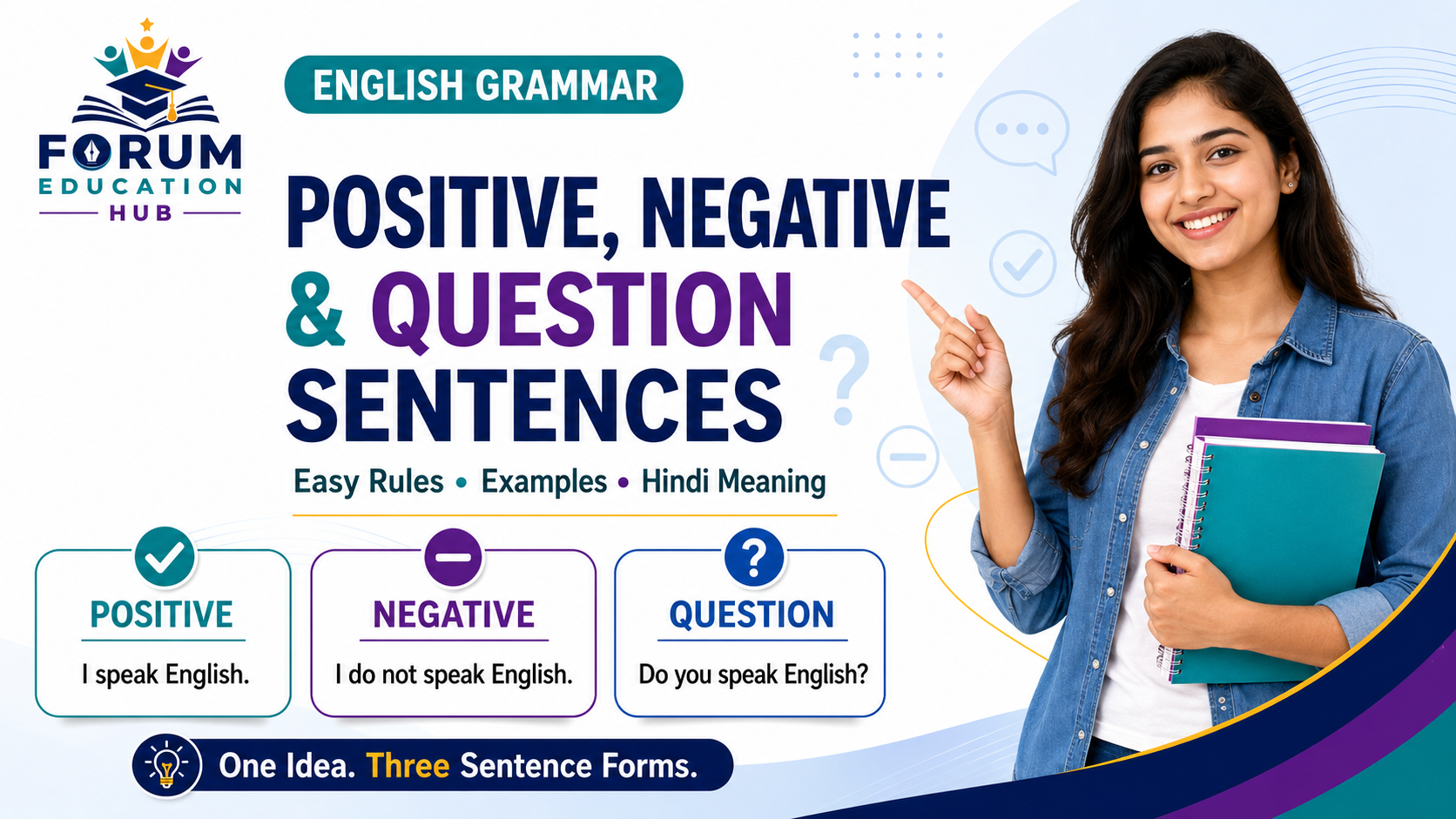
Learn positive, negative, and question sentences in English with simple grammar rules, Hindi meanings, practical examples, common mistakes, and exercises.
Suppose you want to say:
I speak English.
Now you want to say the opposite:
I do not speak English.
Next, you want to ask someone:
Do you speak English?
These three sentences express different ideas:
- Positive sentence: I speak English.
- Negative sentence: I do not speak English.
- Question sentence: Do you speak English?
Learning how to change one sentence into these three forms is one of the most useful skills for speaking English confidently.
In this guide, you will learn easy rules, Hindi explanations, sentence structures, everyday examples, common mistakes, and practice exercises.
What Is a Positive Sentence?
A positive sentence states that something happens, exists, or is true.
It is also called an affirmative sentence.
Hindi meaning: Positive sentence वह वाक्य है जिसमें किसी कार्य, स्थिति या जानकारी को सामान्य रूप से बताया जाता है।
Examples:
I study English.
मैं अंग्रेज़ी पढ़ता हूँ।
She works in an office.
वह एक कार्यालय में काम करती है।
They attend online classes.
वे ऑनलाइन कक्षाओं में शामिल होते हैं।
He is confident.
वह आत्मविश्वासी है।
Basic Structure
Subject + Verb + Object
Example:
She + reads + books.
Complete sentence:
She reads books.
However, some positive sentences use different patterns:
She is happy.
The students arrived.
What Is a Negative Sentence?
A negative sentence states that something does not happen, does not exist, or is not true.
Hindi meaning: Negative sentence वह वाक्य है जिसमें किसी कार्य या स्थिति के न होने की जानकारी दी जाती है।
Examples:
I do not study at night.
मैं रात में नहीं पढ़ता हूँ।
She does not drink coffee.
वह कॉफी नहीं पीती है।
They are not ready.
वे तैयार नहीं हैं।
He cannot attend the meeting.
वह बैठक में शामिल नहीं हो सकता।
Common Negative Words
- Not.
- Never.
- No.
- Nobody.
- Nothing.
- Nowhere.
- Cannot.
For beginners, the easiest starting point is:
Helping verb + not
Examples:
Do not.
Does not.
Did not.
Is not.
Are not.
Will not.
Cannot.
What Is a Question Sentence?
A question sentence asks for information or confirmation.
It is also called an interrogative sentence.
Hindi meaning: Question sentence वह वाक्य है जिसमें किसी व्यक्ति से जानकारी या उत्तर पूछा जाता है।
Examples:
Do you study English?
क्या आप अंग्रेज़ी पढ़ते हैं?
Does she work here?
क्या वह यहाँ काम करती है?
Are they ready?
क्या वे तैयार हैं?
When does your class begin?
आपकी कक्षा कब शुरू होती है?
Two Common Types of Questions
Yes/no questions:
Do you attend English classes?
Answer:
Yes, I do.
WH questions:
Why do you attend English classes?
Answer:
I attend English classes to improve my communication.
One Sentence, Three Forms
Let us look at the same idea in different forms:
| Sentence Type | Example | Hindi Meaning |
|---|---|---|
| Positive | I speak English. | मैं अंग्रेज़ी बोलता हूँ। |
| Negative | I do not speak English. | मैं अंग्रेज़ी नहीं बोलता हूँ। |
| Question | Do I speak English? | क्या मैं अंग्रेज़ी बोलता हूँ? |
Another example:
| Sentence Type | Example | Hindi Meaning |
|---|---|---|
| Positive | She studies every day. | वह प्रतिदिन पढ़ती है। |
| Negative | She does not study every day. | वह प्रतिदिन नहीं पढ़ती है। |
| Question | Does she study every day? | क्या वह प्रतिदिन पढ़ती है? |
Notice that the helping verb changes depending on the subject and tense.
Present Simple: Positive Sentences
Use the present simple to talk about:
- Daily routines.
- Habits.
- Regular activities.
- General facts.
With I, YOU, WE, and THEY
Structure:
Subject + Base Verb + Object
Examples:
I practise English.
मैं अंग्रेज़ी का अभ्यास करता हूँ।
You understand the lesson.
आप पाठ समझते हैं।
We attend online classes.
हम ऑनलाइन कक्षाओं में शामिल होते हैं।
They play cricket.
वे क्रिकेट खेलते हैं।
With HE, SHE, and IT
Structure:
Subject + Verb with S/ES + Object
Examples:
He practises English.
वह अंग्रेज़ी का अभ्यास करता है।
She understands the lesson.
वह पाठ समझती है।
It works properly.
यह सही तरीके से काम करता है।
Rahul watches educational videos.
राहुल शैक्षिक वीडियो देखता है।
Important Rule
With he, she, and it, many verbs take s or es.
- Speak → speaks.
- Read → reads.
- Watch → watches.
- Go → goes.
- Study → studies.
- Practise → practises.
Examples:
✅ She speaks English.
❌ She speak English.
✅ He studies regularly.
❌ He study regularly.
Present Simple: Negative Sentences
With I, YOU, WE, and THEY
Structure:
Subject + do not + base verb + object
Examples:
I do not miss my class.
मैं अपनी कक्षा नहीं छोड़ता हूँ।
You do not understand the question.
आप प्रश्न नहीं समझते हैं।
We do not waste time.
हम समय बर्बाद नहीं करते हैं।
They do not play cricket at night.
वे रात में क्रिकेट नहीं खेलते हैं।
With HE, SHE, and IT
Structure:
Subject + does not + base verb + object
Examples:
He does not miss his class.
वह अपनी कक्षा नहीं छोड़ता है।
She does not drink tea.
वह चाय नहीं पीती है।
It does not work properly.
यह सही तरीके से काम नहीं करता है।
Priya does not study late at night.
प्रिया देर रात तक नहीं पढ़ती है।
Important Rule
After does not, use the base form of the verb.
✅ She does not speak English.
❌ She does not speaks English.
✅ He does not go to the office on Sunday.
❌ He does not goes to the office on Sunday.
Short Forms
- Do not = don’t.
- Does not = doesn’t.
Examples:
I don’t understand.
She doesn’t attend the evening class.
Present Simple: Question Sentences
With I, YOU, WE, and THEY
Structure:
Do + subject + base verb + object?
Examples:
Do you speak English?
क्या आप अंग्रेज़ी बोलते हैं?
Do they attend the class?
क्या वे कक्षा में शामिल होते हैं?
Do we need a notebook?
क्या हमें नोटबुक की आवश्यकता है?
With HE, SHE, and IT
Structure:
Does + subject + base verb + object?
Examples:
Does she speak English?
क्या वह अंग्रेज़ी बोलती है?
Does he work in Surat?
क्या वह सूरत में काम करता है?
Does the class start at 9 PM?
क्या कक्षा रात 9 बजे शुरू होती है?
Important Rule
After does, use the base form.
✅ Does she read books?
❌ Does she reads books?
✅ Does he study English?
❌ Does he studies English?
Present Simple Comparison
| Subject | Positive | Negative | Question |
|---|---|---|---|
| I | I practise English. | I do not practise English. | Do I practise English? |
| You | You practise English. | You do not practise English. | Do you practise English? |
| He | He practises English. | He does not practise English. | Does he practise English? |
| She | She practises English. | She does not practise English. | Does she practise English? |
| We | We practise English. | We do not practise English. | Do we practise English? |
| They | They practise English. | They do not practise English. | Do they practise English? |
Sentences with AM, IS, and ARE
Use am, is, and are to describe:
- Identity.
- Condition.
- Feelings.
- Location.
- Ongoing actions.
Positive Structure
Subject + am/is/are + complement
Examples:
I am a student.
मैं एक विद्यार्थी हूँ।
She is confident.
वह आत्मविश्वासी है।
They are ready.
वे तैयार हैं।
We are at home.
हम घर पर हैं।
Negative Structure
Subject + am/is/are + not + complement
Examples:
I am not tired.
मैं थका हुआ नहीं हूँ।
She is not nervous.
वह घबराई हुई नहीं है।
They are not late.
वे देर से नहीं आए हैं।
We are not busy.
हम व्यस्त नहीं हैं।
Question Structure
Am/Is/Are + subject + complement?
Examples:
Am I late?
क्या मैं देर से आया हूँ?
Is she ready?
क्या वह तैयार है?
Are they students?
क्या वे विद्यार्थी हैं?
Are you at home?
क्या आप घर पर हैं?
Comparison
| Positive | Negative | Question |
|---|---|---|
| I am ready. | I am not ready. | Am I ready? |
| He is confident. | He is not confident. | Is he confident? |
| She is busy. | She is not busy. | Is she busy? |
| We are prepared. | We are not prepared. | Are we prepared? |
| They are at home. | They are not at home. | Are they at home? |
Common Short Forms
- Is not = isn’t.
- Are not = aren’t.
Examples:
She isn’t available.
They aren’t late.
Present Continuous Sentences
Use the present continuous for actions happening now.
Positive Structure
Subject + am/is/are + verb-ing
Examples:
I am learning English.
मैं अंग्रेज़ी सीख रहा हूँ।
She is reading a book.
वह किताब पढ़ रही है।
They are attending a class.
वे कक्षा में शामिल हो रहे हैं।
Negative Structure
Subject + am/is/are + not + verb-ing
Examples:
I am not sleeping.
मैं सो नहीं रहा हूँ।
She is not watching television.
वह टेलीविज़न नहीं देख रही है।
They are not playing cricket.
वे क्रिकेट नहीं खेल रहे हैं।
Question Structure
Am/Is/Are + subject + verb-ing?
Examples:
Are you learning English?
क्या आप अंग्रेज़ी सीख रहे हैं?
Is she reading a book?
क्या वह किताब पढ़ रही है?
Are they attending the meeting?
क्या वे बैठक में शामिल हो रहे हैं?
Comparison
Positive: She is studying.
Negative: She is not studying.
Question: Is she studying?
Past Simple Sentences
Use the past simple for completed actions in the past.
Positive Structure
Subject + past verb + object
Examples:
I attended the class yesterday.
मैं कल कक्षा में शामिल हुआ।
She completed her homework.
उसने अपना होमवर्क पूरा किया।
They watched a movie.
उन्होंने एक फिल्म देखी।
He went to the office.
वह कार्यालय गया।
Negative Structure
Subject + did not + base verb + object
Examples:
I did not attend the class yesterday.
मैं कल कक्षा में शामिल नहीं हुआ।
She did not complete her homework.
उसने अपना होमवर्क पूरा नहीं किया।
They did not watch a movie.
उन्होंने फिल्म नहीं देखी।
He did not go to the office.
वह कार्यालय नहीं गया।
Question Structure
Did + subject + base verb + object?
Examples:
Did you attend the class?
क्या आप कक्षा में शामिल हुए?
Did she complete her homework?
क्या उसने अपना होमवर्क पूरा किया?
Did they watch the movie?
क्या उन्होंने फिल्म देखी?
Did he go to the office?
क्या वह कार्यालय गया?
Important Rule
After did or did not, use the base verb.
✅ Did you go?
❌ Did you went?
✅ She did not complete the task.
❌ She did not completed the task.
Short Form
- Did not = didn’t.
Example:
I didn’t understand the question.
Sentences with WAS and WERE
Use was and were to describe past conditions, locations, and situations.
Positive Structure
Subject + was/were + complement
Examples:
I was busy.
मैं व्यस्त था।
She was nervous.
वह घबराई हुई थी।
They were at home.
वे घर पर थे।
We were ready.
हम तैयार थे।
Negative Structure
Subject + was/were + not + complement
Examples:
I was not late.
मैं देर से नहीं आया था।
She was not nervous.
वह घबराई हुई नहीं थी।
They were not at home.
वे घर पर नहीं थे।
Question Structure
Was/Were + subject + complement?
Examples:
Was he at the office?
क्या वह कार्यालय में था?
Was she confident?
क्या वह आत्मविश्वासी थी?
Were they ready?
क्या वे तैयार थे?
Short Forms
- Was not = wasn’t.
- Were not = weren’t.
Future Simple Sentences
Use will to talk about future actions.
Positive Structure
Subject + will + base verb + object
Examples:
I will attend the class tomorrow.
मैं कल कक्षा में शामिल होऊँगा।
She will call you in the evening.
वह आपको शाम को कॉल करेगी।
They will practise speaking.
वे बोलने का अभ्यास करेंगे।
Negative Structure
Subject + will not + base verb + object
Examples:
I will not miss the meeting.
मैं बैठक नहीं छोड़ूँगा।
She will not arrive late.
वह देर से नहीं आएगी।
They will not waste time.
वे समय बर्बाद नहीं करेंगे।
Question Structure
Will + subject + base verb + object?
Examples:
Will you attend the class?
क्या आप कक्षा में शामिल होंगे?
Will she call me?
क्या वह मुझे कॉल करेगी?
Will they complete the assignment?
क्या वे असाइनमेंट पूरा करेंगे?
Short Form
- Will not = won’t.
Example:
I won’t miss the class.
Present Perfect Sentences
Use the present perfect to connect a past action with the present.
Positive Structure
Subject + have/has + past participle
Examples:
I have completed my homework.
मैं अपना होमवर्क पूरा कर चुका हूँ।
She has joined the class.
वह कक्षा जॉइन कर चुकी है।
They have finished the assignment.
वे असाइनमेंट पूरा कर चुके हैं।
Negative Structure
Subject + have/has + not + past participle
Examples:
I have not completed the exercise.
मैंने अभ्यास पूरा नहीं किया है।
She has not joined the meeting.
वह बैठक से नहीं जुड़ी है।
They have not finished their work.
उन्होंने अपना काम पूरा नहीं किया है।
Question Structure
Have/Has + subject + past participle?
Examples:
Have you completed the exercise?
क्या आपने अभ्यास पूरा कर लिया है?
Has she joined the class?
क्या वह कक्षा से जुड़ गई है?
Have they finished their work?
क्या उन्होंने अपना काम पूरा कर लिया है?
Short Forms
- Have not = haven’t.
- Has not = hasn’t.
Sentences with CAN
Use can to talk about ability or possibility.
Positive Structure
Subject + can + base verb
Examples:
I can speak English.
मैं अंग्रेज़ी बोल सकता हूँ।
She can solve the problem.
वह समस्या हल कर सकती है।
They can join the class.
वे कक्षा से जुड़ सकते हैं।
Negative Structure
Subject + cannot + base verb
Examples:
I cannot attend today.
मैं आज शामिल नहीं हो सकता।
She cannot hear you.
वह आपको सुन नहीं सकती।
They cannot find the link.
वे लिंक नहीं ढूँढ़ सकते।
Question Structure
Can + subject + base verb?
Examples:
Can you speak English?
क्या आप अंग्रेज़ी बोल सकते हैं?
Can she help me?
क्या वह मेरी मदद कर सकती है?
Can they join the meeting?
क्या वे बैठक से जुड़ सकते हैं?
Short Form
- Cannot = can’t.
Example:
I can’t hear you clearly.
Sentences with SHOULD
Use should to give advice or suggestions.
Positive
You should practise English daily.
आपको प्रतिदिन अंग्रेज़ी का अभ्यास करना चाहिए।
Negative
You should not be afraid of mistakes.
आपको गलतियों से डरना नहीं चाहिए।
Question
Should I practise speaking every day?
क्या मुझे प्रतिदिन बोलने का अभ्यास करना चाहिए?
More Examples
You should carry a notebook.
You should not miss the class.
Should we revise the lesson?
Short Form
- Should not = shouldn’t.
Sentences with MUST
Use must to express strong necessity.
Positive
You must follow the instructions.
आपको निर्देशों का पालन करना आवश्यक है।
Negative
You must not share confidential information.
आपको गोपनीय जानकारी साझा नहीं करनी चाहिए।
Question
Must I complete the assignment today?
क्या मुझे आज ही असाइनमेंट पूरा करना आवश्यक है?
Important Difference
Must not means something is prohibited.
You must not enter this room.
आपको इस कमरे में प्रवेश नहीं करना चाहिए।
Do not have to means something is not necessary.
You do not have to arrive early.
आपको जल्दी पहुँचना आवश्यक नहीं है।
These two expressions have different meanings.
Complete Sentence Conversion Chart
| Form | Positive | Negative | Question |
|---|---|---|---|
| Present Simple | She studies English. | She does not study English. | Does she study English? |
| Present Continuous | She is studying English. | She is not studying English. | Is she studying English? |
| Past Simple | She studied English. | She did not study English. | Did she study English? |
| Past Continuous | She was studying English. | She was not studying English. | Was she studying English? |
| Present Perfect | She has studied English. | She has not studied English. | Has she studied English? |
| Future Simple | She will study English. | She will not study English. | Will she study English? |
| Ability | She can study English. | She cannot study English. | Can she study English? |
| Advice | She should study English. | She should not study English. | Should she study English? |
How to Change a Positive Sentence into a Negative Sentence
Step 1: Identify the Main Verb or Helping Verb
Example:
She studies English.
There is no separate helping verb.
Step 2: Choose the Correct Helping Verb
The subject is she, so use does.
Step 3: Add NOT
She does not study English.
Step 4: Use the Base Verb
✅ She does not study English.
❌ She does not studies English.
Another Example
Positive:
They are ready.
The helping verb is already present:
are.
Add not:
They are not ready.
How to Change a Positive Sentence into a Question
Example 1: Present Simple
Positive:
He works in Surat.
Add does before the subject:
Does he work in Surat?
Example 2: Sentence with IS
Positive:
She is ready.
Move is before the subject:
Is she ready?
Example 3: Future Sentence
Positive:
They will attend the meeting.
Move will before the subject:
Will they attend the meeting?
Example 4: Sentence with CAN
Positive:
You can solve the problem.
Move can before the subject:
Can you solve the problem?
WH Questions in Positive and Negative Forms
You can add question words such as:
- What.
- Where.
- When.
- Why.
- Who.
- Which.
- How.
Examples
Positive statement:
She studies English.
Question:
What does she study?
Negative statement:
She does not study English.
Negative question:
Why doesn’t she study English?
More Examples
Where do you live?
आप कहाँ रहते हैं?
Why does he practise every day?
वह प्रतिदिन अभ्यास क्यों करता है?
When did they arrive?
वे कब पहुँचे?
How can I improve my English?
मैं अपनी अंग्रेज़ी कैसे सुधार सकता हूँ?
Negative Questions
Negative questions can express surprise, confirm information, or make suggestions.
Examples:
Don’t you attend the English class?
क्या आप अंग्रेज़ी की कक्षा में शामिल नहीं होते?
Isn’t she your teacher?
क्या वह आपकी शिक्षक नहीं हैं?
Didn’t he call you?
क्या उसने आपको कॉल नहीं किया?
Can’t we discuss this tomorrow?
क्या हम इस पर कल चर्चा नहीं कर सकते?
Common Pattern
Negative helping verb + subject + main verb?
Examples:
Don’t you understand?
Doesn’t she work here?
Didn’t they join the meeting?
Polite Suggestion
Why don’t we practise together?
हम साथ में अभ्यास क्यों नहीं करते?
Common Contractions in Spoken English
Contractions make everyday conversations sound more natural.
| Full Form | Short Form |
|---|---|
| Do not | Don’t |
| Does not | Doesn’t |
| Did not | Didn’t |
| Is not | Isn’t |
| Are not | Aren’t |
| Was not | Wasn’t |
| Were not | Weren’t |
| Have not | Haven’t |
| Has not | Hasn’t |
| Will not | Won’t |
| Cannot | Can’t |
| Should not | Shouldn’t |
| Must not | Mustn’t |
Examples:
I don’t understand.
She doesn’t feel confident.
They aren’t ready.
He won’t arrive late.
We can’t hear the teacher.
Everyday Sentence Examples
Speaking English
Positive:
I speak English.
मैं अंग्रेज़ी बोलता हूँ।
Negative:
I do not speak English.
मैं अंग्रेज़ी नहीं बोलता हूँ।
Question:
Do you speak English?
क्या आप अंग्रेज़ी बोलते हैं?
Attending Classes
Positive:
She attends online classes.
वह ऑनलाइन कक्षाओं में शामिल होती है।
Negative:
She does not attend online classes.
वह ऑनलाइन कक्षाओं में शामिल नहीं होती है।
Question:
Does she attend online classes?
क्या वह ऑनलाइन कक्षाओं में शामिल होती है?
Being Ready
Positive:
They are ready.
वे तैयार हैं।
Negative:
They are not ready.
वे तैयार नहीं हैं।
Question:
Are they ready?
क्या वे तैयार हैं?
Practising Daily
Positive:
We practise every day.
हम प्रतिदिन अभ्यास करते हैं।
Negative:
We do not practise every day.
हम प्रतिदिन अभ्यास नहीं करते हैं।
Question:
Do we practise every day?
क्या हम प्रतिदिन अभ्यास करते हैं?
Completing Homework
Positive:
He completed his homework.
उसने अपना होमवर्क पूरा किया।
Negative:
He did not complete his homework.
उसने अपना होमवर्क पूरा नहीं किया।
Question:
Did he complete his homework?
क्या उसने अपना होमवर्क पूरा किया?
Joining Tomorrow
Positive:
I will join tomorrow.
मैं कल जुड़ूँगा।
Negative:
I will not join tomorrow.
मैं कल नहीं जुड़ूँगा।
Question:
Will you join tomorrow?
क्या आप कल जुड़ेंगे?
Hearing Clearly
Positive:
She can hear the teacher.
वह शिक्षक को सुन सकती है।
Negative:
She cannot hear the teacher.
वह शिक्षक को नहीं सुन सकती है।
Question:
Can she hear the teacher?
क्या वह शिक्षक को सुन सकती है?
Sample Conversation
Teacher: Do you practise English every day?
Student: Yes, I practise English every evening.
Teacher: Do you watch English videos?
Student: Yes, I do, but I do not understand every word.
Teacher: That is normal. Are you writing down new words?
Student: Yes, I am writing them in my notebook.
Teacher: Can you use those words in sentences?
Student: I can use some of them, but I cannot remember all of them.
Teacher: Do not worry. Will you practise again tomorrow?
Student: Yes, I will practise tomorrow.
Hindi Meaning
शिक्षक: क्या आप प्रतिदिन अंग्रेज़ी का अभ्यास करते हैं?
विद्यार्थी: हाँ, मैं हर शाम अंग्रेज़ी का अभ्यास करता हूँ।
शिक्षक: क्या आप अंग्रेज़ी वीडियो देखते हैं?
विद्यार्थी: हाँ, लेकिन मैं हर शब्द नहीं समझता हूँ।
शिक्षक: यह सामान्य है। क्या आप नए शब्द लिख रहे हैं?
विद्यार्थी: हाँ, मैं उन्हें अपनी नोटबुक में लिख रहा हूँ।
शिक्षक: क्या आप उन शब्दों का वाक्यों में उपयोग कर सकते हैं?
विद्यार्थी: मैं कुछ शब्दों का उपयोग कर सकता हूँ, लेकिन सभी याद नहीं रख सकता।
शिक्षक: चिंता मत कीजिए। क्या आप कल फिर अभ्यास करेंगे?
विद्यार्थी: हाँ, मैं कल अभ्यास करूँगा।
Common Mistakes and Corrections
Mistake 1: Using DOES with a Verb Ending in S
❌ Does she speaks English?
✅ Does she speak English?
After does, use the base verb.
Mistake 2: Using DOES NOT with a Verb Ending in S
❌ He does not likes coffee.
✅ He does not like coffee.
Mistake 3: Using DID with the Past Verb
❌ Did you went to the class?
✅ Did you go to the class?
Mistake 4: Using DID NOT with the Past Verb
❌ She did not completed the assignment.
✅ She did not complete the assignment.
Mistake 5: Forgetting the Helping Verb
❌ You understand the lesson?
✅ Do you understand the lesson?
In informal speech, the first version can appear with rising intonation, but the second is the standard question structure.
Mistake 6: Using DO with AM, IS, or ARE
❌ Do you are ready?
✅ Are you ready?
Mistake 7: Incorrect Word Order
❌ She is ready?
✅ Is she ready?
The first version may occur informally, but the second is the standard direct question.
Mistake 8: Using a Double Negative
❌ I do not know nothing.
✅ I do not know anything.
Another correct option:
✅ I know nothing.
Mistake 9: Confusing CANNOT and CAN
❌ She can not speaks English.
✅ She cannot speak English.
Use the base verb after can or cannot.
Mistake 10: Forgetting the Question Mark
❌ Do you attend online classes.
✅ Do you attend online classes?
Mistake 11: Adding DO Before a Modal Verb
❌ Do you can speak English?
✅ Can you speak English?
Mistake 12: Using the Wrong Helping Verb
❌ Does they attend the class?
✅ Do they attend the class?
Use:
- Do with I, you, we, and they.
- Does with he, she, and it.
Practice Exercise 1: Change Positive Sentences into Negative Sentences
- I speak English.
- She reads books.
- They attend online classes.
- He is confident.
- We are ready.
- She completed the assignment.
- They will join the meeting.
- He can solve the problem.
- I am studying grammar.
- She has finished her homework.
Answers
- I do not speak English.
- She does not read books.
- They do not attend online classes.
- He is not confident.
- We are not ready.
- She did not complete the assignment.
- They will not join the meeting.
- He cannot solve the problem.
- I am not studying grammar.
- She has not finished her homework.
Practice Exercise 2: Change Positive Sentences into Questions
- You speak English.
- She works in an office.
- They are ready.
- He is attending the class.
- We completed the assignment.
- She will call you.
- They can help us.
- He has finished the work.
- You should practise daily.
- She was at home.
Answers
- Do you speak English?
- Does she work in an office?
- Are they ready?
- Is he attending the class?
- Did we complete the assignment?
- Will she call you?
- Can they help us?
- Has he finished the work?
- Should you practise daily?
- Was she at home?
Practice Exercise 3: Identify the Sentence Type
Write whether each sentence is positive, negative, or a question.
- She does not drink tea.
- Are you ready?
- We practise English every day.
- He cannot attend the class.
- Did they complete the task?
- My brother works in Surat.
- They are not at home.
- Will you join tomorrow?
- I have completed my homework.
- She does not understand the lesson.
Answers
- Negative.
- Question.
- Positive.
- Negative.
- Question.
- Positive.
- Negative.
- Question.
- Positive.
- Negative.
Practice Exercise 4: Correct the Mistakes
- Does he speaks English?
- She do not attend the class.
- Did you completed your homework?
- Do you are ready?
- They is not at home.
- Can she writes an email?
- He did not went to the office.
- Does they understand the lesson?
- She will not joins tomorrow.
- I do not know nothing.
Correct Answers
- Does he speak English?
- She does not attend the class.
- Did you complete your homework?
- Are you ready?
- They are not at home.
- Can she write an email?
- He did not go to the office.
- Do they understand the lesson?
- She will not join tomorrow.
- I do not know anything.
Check Your Progress
- 36–40 correct: Excellent understanding.
- 30–35 correct: Strong progress.
- 20–29 correct: Review helping verbs and sentence structure.
- Below 20: Practise one sentence pattern at a time and repeat the exercises.
Seven-Day Sentence Practice Plan
Day 1: Practise Positive Sentences
Write ten sentences about your daily routine:
I wake up early.
I drink tea.
I attend my English class.
I practise speaking.
Day 2: Convert Them into Negative Sentences
Examples:
I do not wake up late.
I do not miss my class.
I do not stop practising.
Day 3: Convert Them into Questions
Examples:
Do you wake up early?
Do you attend your English class?
Do you practise speaking?
Day 4: Practise HE and SHE Sentences
Positive:
She speaks English.
Negative:
She does not speak English.
Question:
Does she speak English?
Day 5: Practise Past and Future
Past:
I attended the class.
I did not attend the class.
Did you attend the class?
Future:
I will attend the class.
I will not attend the class.
Will you attend the class?
Day 6: Practise AM, IS, ARE, and CAN
Examples:
I am ready.
I am not ready.
Am I ready?
She can speak clearly.
She cannot speak clearly.
Can she speak clearly?
Day 7: Have a Complete Conversation
Ask and answer questions with a friend:
Do you practise English?
Yes, I practise every day.
Do you find grammar difficult?
Sometimes, but I do not give up.
Will you continue learning?
Yes, I will continue learning.
Frequently Asked Questions
What is a positive sentence?
A positive sentence states that something happens or is true.
Example:
She speaks English.
What is a negative sentence?
A negative sentence states that something does not happen or is not true.
Example:
She does not speak English.
What is a question sentence?
A question sentence asks for information or confirmation.
Example:
Does she speak English?
What is the difference between DO and DOES?
Use do with:
- I.
- You.
- We.
- They.
Use does with:
- He.
- She.
- It.
- Singular nouns.
Examples:
Do you speak English?
Does she speak English?
Why do we say “Does she speak” instead of “Does she speaks”?
Because does already carries the grammatical information. The main verb remains in its base form.
Correct:
Does she speak English?
When do we use DID?
Use did in many past simple negative sentences and questions.
Examples:
Did you attend the class?
I did not attend the class.
Can we use DO with IS or ARE?
Generally, no.
❌ Do you are ready?
✅ Are you ready?
What is the negative form of WILL?
The negative form is:
Will not.
The short form is:
Won’t.
Example:
I will not miss the meeting.
I won’t miss the meeting.
What is the negative form of CAN?
The negative form is:
Cannot.
The short form is:
Can’t.
Example:
I cannot hear you.
I can’t hear you.
How can I practise all three sentence types?
Choose a simple sentence and convert it into three forms.
Example:
Positive: I attend the class.
Negative: I do not attend the class.
Question: Do I attend the class?
Practise with different subjects, verbs, and tenses.
Final Thoughts
Positive, negative, and question sentences form the foundation of everyday English communication.
Once you learn how helping verbs work, you can communicate the same idea in multiple ways.
Remember:
Positive: She speaks English.
Negative: She does not speak English.
Question: Does she speak English?
Start with simple daily-use sentences. Then practise different subjects, tenses, and question patterns.
With regular practice, correct sentence formation will become more natural and automatic.
Improve Your Spoken English with Forum Education Hub
At Forum Education Hub, we help students, job seekers, and professionals improve practical English communication through grammar practice, daily conversations, vocabulary development, and confidence-building activities.
Forum Education Hub
Learn • Speak • Grow • Succeed