
Spoken English
150 Daily Use English Sentences with Hindi Meaning for Spoken English
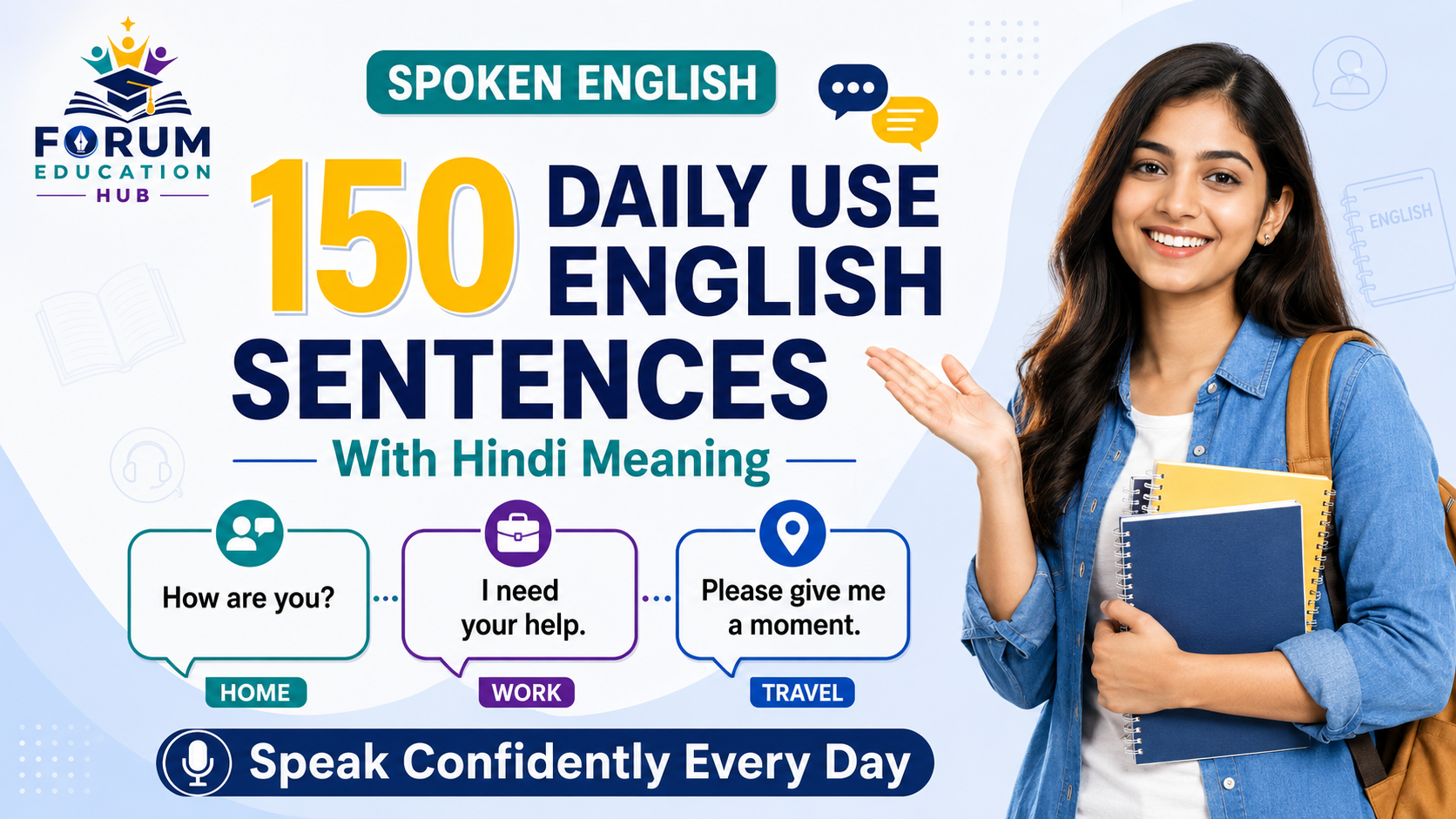
Learn 150 daily use English sentences with Hindi meaning for home, work, shopping, travel, interviews, and confident everyday conversations.
Do you understand English but hesitate when you need to speak?
You are not alone.
Many learners know grammar rules and vocabulary but struggle to form simple sentences during everyday conversations.
For example:
मुझे समझ नहीं आया।
You may know the words but hesitate before saying:
I didn’t understand.
Or:
मुझे थोड़ा समय दीजिए।
You can say:
Please give me a moment.
The easiest way to improve spoken English is to practise useful sentences from real situations.
This guide contains 150 daily use English sentences with Hindi meanings, organized into practical categories such as home, work, shopping, travel, online classes, and interviews.
Why Practise Daily Use English Sentences?
Learning practical sentences helps you:
- Speak naturally during everyday conversations.
- Respond more quickly without translating every word.
- Improve pronunciation and sentence formation.
- Build confidence in social and professional situations.
- Develop useful vocabulary.
- Communicate better during interviews and meetings.
Remember:
You do not need complicated English to communicate effectively.
You need clear, useful sentences and consistent practice.
1. Greetings and Introductions
Use these expressions when meeting someone or starting a conversation.
- Good morning! — सुप्रभात!
- Good afternoon! — नमस्कार!
- Good evening! — शुभ संध्या!
- How are you? — आप कैसे हैं?
- I am doing well, thank you. — मैं अच्छा हूँ, धन्यवाद।
- What is your name? — आपका नाम क्या है?
- My name is Rahul. — मेरा नाम राहुल है।
- Nice to meet you. — आपसे मिलकर अच्छा लगा।
- Where are you from? — आप कहाँ से हैं?
- I am from Gujarat. — मैं गुजरात से हूँ।
Practice Conversation
A: Good morning! How are you?
B: I am doing well, thank you. How are you?
A: I am fine. What is your name?
B: My name is Priya. Nice to meet you.
2. English Sentences for Home and Family
Use these sentences while speaking with family members.
- Please open the door. — कृपया दरवाज़ा खोलिए।
- Close the window, please. — कृपया खिड़की बंद कीजिए।
- The food is ready. — खाना तैयार है।
- Please switch off the lights. — कृपया लाइट बंद कर दीजिए।
- Where is my phone? — मेरा फोन कहाँ है?
- Your bag is on the table. — आपका बैग मेज़ पर है।
- I am helping my mother. — मैं अपनी माँ की मदद कर रहा हूँ।
- My brother is at home. — मेरा भाई घर पर है।
- Let us have dinner together. — चलिए साथ में रात का खाना खाते हैं।
- Please keep the room clean. — कृपया कमरे को साफ रखिए।
Useful Tip
Choose three household activities and describe them in English every day:
I am cleaning the room.
I am preparing tea.
I am arranging my books.
3. English Sentences for Daily Routine
Describe your everyday activities with these expressions.
- I wake up early in the morning. — मैं सुबह जल्दी उठता हूँ।
- I brush my teeth. — मैं अपने दाँत साफ करता हूँ।
- I take a shower. — मैं स्नान करता हूँ।
- I get ready for work. — मैं काम के लिए तैयार होता हूँ।
- I have breakfast at 8 AM. — मैं सुबह 8 बजे नाश्ता करता हूँ।
- I leave home in the morning. — मैं सुबह घर से निकलता हूँ।
- I come back in the evening. — मैं शाम को वापस आता हूँ।
- I complete my daily tasks. — मैं अपने दैनिक कार्य पूरे करता हूँ।
- I spend time with my family. — मैं अपने परिवार के साथ समय बिताता हूँ।
- I go to bed at night. — मैं रात में सोने जाता हूँ।
Example Paragraph
I wake up early in the morning. I brush my teeth and take a shower. After breakfast, I get ready for work. In the evening, I spend time with my family and practise English.
4. English Sentences for Classrooms and Studies
These expressions are useful for students and online learners.
- May I come in? — क्या मैं अंदर आ सकता हूँ?
- Please explain it again. — कृपया इसे फिर से समझाइए।
- I have a question. — मेरा एक प्रश्न है।
- I did not understand the topic. — मुझे यह विषय समझ नहीं आया।
- Could you repeat the sentence? — क्या आप वाक्य दोहरा सकते हैं?
- I have completed my homework. — मैंने अपना होमवर्क पूरा कर लिया है।
- Please share the notes with me. — कृपया मेरे साथ नोट्स साझा कीजिए।
- I am ready for the class. — मैं कक्षा के लिए तैयार हूँ।
- Let us practise together. — चलिए साथ में अभ्यास करते हैं।
- I am improving every day. — मैं प्रतिदिन सुधार कर रहा हूँ।
Classroom Conversation
Student: I have a question.
Teacher: Sure. What would you like to ask?
Student: Could you repeat the sentence?
Teacher: Of course. Let us practise it together.
5. English Sentences for Work and Office
Use these sentences in professional conversations.
- I am working on it. — मैं इस पर काम कर रहा हूँ।
- I will complete the task today. — मैं आज यह काम पूरा कर दूँगा।
- Please send me the details. — कृपया मुझे जानकारी भेजिए।
- Let us discuss this tomorrow. — चलिए इस पर कल चर्चा करते हैं।
- I have scheduled a meeting. — मैंने एक बैठक निर्धारित की है।
- Please check your email. — कृपया अपना ईमेल देखिए।
- I need some more information. — मुझे कुछ और जानकारी चाहिए।
- Thank you for your support. — आपके सहयोग के लिए धन्यवाद।
- I will update you shortly. — मैं आपको थोड़ी देर में जानकारी दूँगा।
- We can find a solution. — हम इसका समाधान ढूँढ़ सकते हैं।
Professional Tip
Instead of saying:
Send details.
Say:
Could you please send me the details?
It sounds more polite and professional.
6. English Sentences for Phone Calls and Online Meetings
These expressions are useful for calls, Zoom classes, and online discussions.
- Can you hear me clearly? — क्या आप मुझे स्पष्ट रूप से सुन सकते हैं?
- Your voice is breaking up. — आपकी आवाज़ बीच-बीच में कट रही है।
- Please turn on your microphone. — कृपया अपना माइक्रोफोन चालू कीजिए।
- Please mute your microphone. — कृपया अपना माइक्रोफोन म्यूट कर दीजिए।
- I will call you back. — मैं आपको वापस कॉल करूँगा।
- Please send me the meeting link. — कृपया मुझे मीटिंग का लिंक भेजिए।
- I have joined the meeting. — मैं मीटिंग से जुड़ गया हूँ।
- My internet connection is unstable. — मेरा इंटरनेट कनेक्शन स्थिर नहीं है।
- Could you share your screen? — क्या आप अपनी स्क्रीन साझा कर सकते हैं?
- Let me know when you are available. — जब आप उपलब्ध हों, तो मुझे बताइए।
Online Class Conversation
Teacher: Can you hear me clearly?
Student: Yes, but your voice is breaking up slightly.
Teacher: I will check my internet connection.
Student: Thank you. Could you also share your screen?
7. English Sentences for Shopping
Practise these expressions while buying products.
- How much does this cost? — इसकी कीमत कितनी है?
- Do you have this in another colour? — क्या यह किसी दूसरे रंग में उपलब्ध है?
- I am just looking around. — मैं बस देख रहा हूँ।
- This is too expensive. — यह बहुत महँगा है।
- Do you have a smaller size? — क्या आपके पास छोटा आकार है?
- Can I pay online? — क्या मैं ऑनलाइन भुगतान कर सकता हूँ?
- Please give me the bill. — कृपया मुझे बिल दीजिए।
- I would like to buy this. — मैं इसे खरीदना चाहूँगा।
- Is there any discount available? — क्या इस पर कोई छूट उपलब्ध है?
- Please pack it properly. — कृपया इसे अच्छी तरह पैक कर दीजिए।
Shopping Conversation
Customer: How much does this cost?
Shopkeeper: It costs ₹500.
Customer: Do you have this in another colour?
Shopkeeper: Yes, it is also available in blue.
Customer: Great. I would like to buy it.
8. English Sentences for Travel and Directions
These sentences can help you navigate unfamiliar places.
- Where is the nearest bus stop? — सबसे नज़दीकी बस स्टॉप कहाँ है?
- How far is the railway station? — रेलवे स्टेशन कितनी दूर है?
- Which bus goes to the city centre? — कौन-सी बस शहर के मुख्य क्षेत्र तक जाती है?
- Please tell me the way. — कृपया मुझे रास्ता बताइए।
- I need a ticket to Ahmedabad. — मुझे अहमदाबाद का टिकट चाहिए।
- What time does the train leave? — ट्रेन कितने बजे निकलती है?
- Is this seat available? — क्या यह सीट खाली है?
- Please stop near the market. — कृपया बाज़ार के पास रोकिए।
- I think we are going the wrong way. — मुझे लगता है कि हम गलत रास्ते पर जा रहे हैं।
- Thank you for your help. — आपकी मदद के लिए धन्यवाद।
Travel Tip
If you do not understand directions, say:
Could you please explain that again?
Or:
Could you show me on the map?
9. English Sentences for Restaurants and Food
Use these expressions while ordering food.
- May I see the menu? — क्या मैं मेनू देख सकता हूँ?
- I would like to order food. — मैं खाना ऑर्डर करना चाहूँगा।
- What do you recommend? — आप क्या सुझाव देंगे?
- Please make it less spicy. — कृपया इसे कम मसालेदार बनाइए।
- I would like a glass of water. — मुझे एक गिलास पानी चाहिए।
- This food tastes delicious. — यह खाना बहुत स्वादिष्ट है।
- Could we have the bill, please? — क्या हमें बिल मिल सकता है?
- Is this dish vegetarian? — क्या यह व्यंजन शाकाहारी है?
- Please bring an extra spoon. — कृपया एक अतिरिक्त चम्मच लाइए।
- We would like to sit near the window. — हम खिड़की के पास बैठना चाहेंगे।
Restaurant Conversation
Server: May I take your order?
Customer: Yes. What do you recommend?
Server: Our vegetable sandwich is popular.
Customer: That sounds good. Please make it less spicy.
10. Polite Requests and Useful Expressions
Polite English improves both personal and professional conversations.
- Could you help me, please? — क्या आप मेरी मदद कर सकते हैं?
- Please give me a moment. — कृपया मुझे एक क्षण दीजिए।
- Would you mind repeating that? — क्या आप इसे दोहरा सकते हैं?
- May I ask you something? — क्या मैं आपसे कुछ पूछ सकता हूँ?
- Could you speak a little more slowly? — क्या आप थोड़ा धीरे बोल सकते हैं?
- Please let me know. — कृपया मुझे बताइए।
- Thank you for your time. — आपके समय के लिए धन्यवाद।
- I really appreciate your help. — मैं आपकी मदद की बहुत सराहना करता हूँ।
- Excuse me for interrupting. — बीच में बोलने के लिए क्षमा कीजिए।
- I am sorry for the inconvenience. — असुविधा के लिए मुझे खेद है।
Direct vs. Polite English
Direct:
Repeat that.
Polite:
Could you please repeat that?
Direct:
Help me.
Polite:
Could you help me, please?
11. English Sentences for Friends and Social Conversations
Use these sentences to maintain friendly conversations.
- What are you doing today? — आप आज क्या कर रहे हैं?
- Let us meet this evening. — चलिए आज शाम मिलते हैं।
- I have not seen you in a long time. — मैंने आपको काफी समय से नहीं देखा है।
- How was your day? — आपका दिन कैसा रहा?
- That sounds interesting. — यह दिलचस्प लग रहा है।
- I completely agree with you. — मैं आपसे पूरी तरह सहमत हूँ।
- What do you think about it? — आप इसके बारे में क्या सोचते हैं?
- I will see you tomorrow. — मैं आपसे कल मिलूँगा।
- Take care of yourself. — अपना ध्यान रखिए।
- Have a wonderful day. — आपका दिन शानदार रहे।
Conversation Tip
Do not answer every question with only:
Yes.
No.
Fine.
Expand your response:
My day was good. I attended my English class and learned new expressions.
12. English Sentences for Feelings and Confidence
Express your emotions clearly with these useful sentences.
- I am feeling happy today. — मैं आज खुश महसूस कर रहा हूँ।
- I am a little nervous. — मैं थोड़ा घबराया हुआ हूँ।
- I feel more confident now. — मैं अब अधिक आत्मविश्वास महसूस करता हूँ।
- I am excited about the opportunity. — मैं इस अवसर को लेकर उत्साहित हूँ।
- I need some time to think. — मुझे सोचने के लिए थोड़ा समय चाहिए।
- I am proud of my progress. — मुझे अपनी प्रगति पर गर्व है।
- I feel better after practising. — अभ्यास करने के बाद मुझे बेहतर महसूस होता है।
- I am not afraid of making mistakes. — मैं गलतियाँ करने से नहीं डरता हूँ।
- I am learning at my own pace. — मैं अपनी गति से सीख रहा हूँ।
- I believe I can improve. — मुझे विश्वास है कि मैं सुधार कर सकता हूँ।
Confidence Reminder
Making mistakes does not mean you are failing.
It means you are practising.
Every mistake teaches you something new.
13. English Sentences for Problems and Help
Use these sentences when you need assistance.
- I need your help. — मुझे आपकी मदद चाहिए।
- I am facing a problem. — मुझे एक समस्या का सामना करना पड़ रहा है।
- I cannot find my notebook. — मुझे अपनी नोटबुक नहीं मिल रही है।
- Something is not working properly. — कुछ सही तरीके से काम नहीं कर रहा है।
- Could you explain the process? — क्या आप प्रक्रिया समझा सकते हैं?
- I do not know what to do. — मुझे नहीं पता कि क्या करना चाहिए।
- Let us solve this together. — चलिए इसे साथ मिलकर हल करते हैं।
- Please check the instructions. — कृपया निर्देश देखिए।
- I think there is a misunderstanding. — मुझे लगता है कि कोई गलतफहमी हुई है।
- The issue has been resolved. — समस्या का समाधान हो गया है।
Useful Professional Expression
Instead of saying:
This is a big problem.
Try:
We are facing a challenge, but we can find a solution.
14. English Sentences for Interviews and Career Growth
Practise these expressions before interviews and professional discussions.
- Thank you for this opportunity. — इस अवसर के लिए धन्यवाद।
- Let me introduce myself. — मुझे अपना परिचय देने दीजिए।
- I am a quick learner. — मैं जल्दी सीखने वाला व्यक्ति हूँ।
- I work well in a team. — मैं टीम में अच्छी तरह काम करता हूँ।
- I am interested in this position. — मुझे इस पद में रुचि है।
- I enjoy learning new skills. — मुझे नए कौशल सीखना पसंद है।
- I can handle responsibilities. — मैं ज़िम्मेदारियाँ संभाल सकता हूँ।
- I am improving my communication skills. — मैं अपने संचार कौशल सुधार रहा हूँ।
- I am looking for growth opportunities. — मैं आगे बढ़ने के अवसर खोज रहा हूँ।
- I would be happy to contribute. — मुझे योगदान देने में खुशी होगी।
Sample Interview Introduction
Good morning. Thank you for this opportunity. My name is Rahul, and I am interested in this position. I am a quick learner, and I enjoy working in a team. I am currently improving my communication skills and looking for opportunities to grow professionally.
15. English Sentences for Practice and Motivation
Use these sentences to maintain a positive learning mindset.
- I practise English every day. — मैं प्रतिदिन अंग्रेज़ी का अभ्यास करता हूँ।
- I am learning new words. — मैं नए शब्द सीख रहा हूँ।
- I am becoming more confident. — मैं अधिक आत्मविश्वासी बन रहा हूँ।
- I will not give up. — मैं हार नहीं मानूँगा।
- I learn from my mistakes. — मैं अपनी गलतियों से सीखता हूँ।
- I can speak clearly. — मैं स्पष्ट रूप से बोल सकता हूँ।
- I am improving step by step. — मैं धीरे-धीरे सुधार कर रहा हूँ।
- Practice makes me better. — अभ्यास मुझे बेहतर बनाता है।
- I am ready to speak English. — मैं अंग्रेज़ी बोलने के लिए तैयार हूँ।
- I believe in myself. — मुझे स्वयं पर विश्वास है।
How to Practise These 150 English Sentences
Reading the sentences once is not enough.
Use this four-step method:
Step 1: Read the English Sentence Aloud
Example:
I am working on it.
Focus on speaking clearly.
Step 2: Understand the Hindi Meaning
मैं इस पर काम कर रहा हूँ।
Make sure you understand the meaning and situation.
Step 3: Repeat It Several Times
Say:
I am working on it.
I am working on it.
I am working on it.
Repetition helps you remember the sentence more naturally.
Step 4: Use It in a Real Situation
If someone asks about your work, respond:
I am working on it.
Using the sentence naturally is more valuable than memorizing it without context.
Learn Sentence Patterns, Not Just Sentences
A single sentence can help you create many more.
Pattern 1: I Am + Action
I am learning English.
Create more:
I am reading a book.
I am preparing for an interview.
I am joining the class.
Pattern 2: I Would Like + Thing or Action
I would like a glass of water.
Create more:
I would like some information.
I would like to join the course.
I would like to ask a question.
Pattern 3: Could You + Action?
Could you help me?
Create more:
Could you repeat that?
Could you explain this?
Could you send me the link?
Pattern 4: I Need + Thing or Action
I need some help.
Create more:
I need more time.
I need a notebook.
I need to practise.
Pattern 5: I Will + Action
I will call you back.
Create more:
I will complete the task.
I will join the meeting.
I will practise tomorrow.
Basic English vs. More Natural English
Learning natural expressions can make your spoken English smoother.
| Basic Expression | Natural Alternative |
|---|---|
| I am very tired. | I am exhausted. |
| I am very hungry. | I am starving. |
| Wait. | Give me a moment. |
| Speak again. | Could you say that again? |
| I do not understand. | I did not quite understand. |
| I am very busy. | I have a lot on my plate. |
| Tell me. | Please let me know. |
| Help me. | Could you help me, please? |
| Come fast. | Please come as soon as you can. |
| I am very happy. | I am delighted. |
Important Note
The basic expressions are not necessarily incorrect.
The natural alternatives simply provide additional ways to communicate depending on the situation.
Common Mistakes in Daily English Conversations
Mistake 1: Translating Directly from Hindi
❌ Myself Rahul.
✅ My name is Rahul.
✅ I am Rahul.
Mistake 2: Incorrect Verb Form
❌ She do not understand.
✅ She does not understand.
Mistake 3: Using an Unnecessary Preposition
❌ Discuss about the problem.
✅ Discuss the problem.
You can also say:
✅ Talk about the problem.
Mistake 4: Incorrect Question Structure
❌ Where you are going?
✅ Where are you going?
Mistake 5: Confusing SAY and TELL
❌ She told that she was busy.
✅ She said that she was busy.
✅ She told me that she was busy.
Mistake 6: Using the Wrong Pronoun
❌ Me and my friend attended the class.
✅ My friend and I attended the class.
Mistake 7: Incorrect Use of DID
❌ Did you went there?
✅ Did you go there?
Mistake 8: Using “Return Back”
❌ I will return back soon.
✅ I will return soon.
✅ I will come back soon.
Mistake 9: Saying “Revert Back”
In standard professional English, avoid:
❌ Please revert back soon.
Prefer:
✅ Please reply soon.
✅ Please get back to me.
Mistake 10: Saying “I Have a Doubt”
In some Indian English contexts, this is widely understood. However, when you want to ask for clarification, a more internationally natural option is:
✅ I have a question.
✅ I would like some clarification.
Three Practical Conversations
Conversation 1: Joining an Online English Class
Student: Hello. Could you send me the meeting link?
Teacher: Certainly. I have sent it to you.
Student: Thank you. I have joined the meeting.
Teacher: Great. Can you hear me clearly?
Student: Yes, I can hear you clearly.
Teacher: Please keep your notebook ready.
Student: Sure. I am ready for the class.
Conversation 2: Speaking at Work
Manager: Have you completed the task?
Employee: I am working on it.
Manager: When will you finish?
Employee: I will complete it today.
Manager: Please send me an update once it is ready.
Employee: Certainly. I will update you shortly.
Conversation 3: Meeting a New Person
A: Hello. What is your name?
B: My name is Neha. Nice to meet you.
A: Nice to meet you too. Where are you from?
B: I am from Ahmedabad.
A: What do you do?
B: I am a college student, and I am learning spoken English.
A: That sounds interesting.
Practice Exercise 1: Translate into English
Translate the following Hindi sentences:
- मुझे आपकी मदद चाहिए।
- कृपया इसे फिर से समझाइए।
- मैं आपको वापस कॉल करूँगा।
- आपकी आवाज़ स्पष्ट नहीं है।
- मैं प्रतिदिन अंग्रेज़ी का अभ्यास करता हूँ।
- कृपया मुझे मीटिंग का लिंक भेजिए।
- क्या आप मेरी मदद कर सकते हैं?
- मैं इस अवसर को लेकर उत्साहित हूँ।
- मुझे थोड़ा समय चाहिए।
- मैं अपनी गलतियों से सीखता हूँ।
Answers
- I need your help.
- Please explain it again.
- I will call you back.
- Your voice is not clear.
- I practise English every day.
- Please send me the meeting link.
- Could you help me?
- I am excited about this opportunity.
- I need some time.
- I learn from my mistakes.
Practice Exercise 2: Complete the Sentences
Fill in the missing words:
- I am working ___ it.
- Please give me a ___.
- Could you ___ the sentence?
- I will call you ___.
- Can you ___ me clearly?
- Please share the meeting ___.
- I am learning new ___.
- We can find a ___.
- Thank you for your ___.
- I believe ___ myself.
Answers
- On.
- Moment.
- Repeat.
- Back.
- Hear.
- Link.
- Words.
- Solution.
- Support.
- In.
Practice Exercise 3: Choose the Natural Response
Question 1
Someone asks:
Can you help me?
A. I help.
B. Sure, I would be happy to help.
Correct answer: B.
Question 2
You cannot hear someone clearly.
A. Your voice is breaking up.
B. Your voice is going.
Correct answer: A.
Question 3
You need a little time.
A. Give me time fast.
B. Please give me a moment.
Correct answer: B.
Question 4
You want someone to repeat a sentence.
A. Speak again.
B. Could you say that again?
Correct answer: B.
Question 5
You want to thank someone professionally.
A. Thank you for your support.
B. Support thanks.
Correct answer: A.
Seven-Day Spoken English Practice Plan
Day 1: Greetings and Introductions
Practise sentences 1–10.
Introduce yourself:
Hello. My name is Priya. I am from Gujarat. Nice to meet you.
Day 2: Home and Daily Routine
Practise sentences 11–30.
Describe your day:
I wake up early. I have breakfast and get ready for work.
Day 3: Classroom and Office Conversations
Practise sentences 31–50.
Examples:
Please explain it again.
I am working on it.
Day 4: Phone Calls and Shopping
Practise sentences 51–70.
Examples:
Can you hear me clearly?
How much does this cost?
Day 5: Travel and Restaurant English
Practise sentences 71–90.
Examples:
Where is the nearest bus stop?
May I see the menu?
Day 6: Polite Conversations and Feelings
Practise sentences 91–120.
Examples:
Could you help me, please?
I am becoming more confident.
Day 7: Problems, Interviews, and Motivation
Practise sentences 121–150.
Examples:
Let us solve this together.
I am a quick learner.
I believe in myself.
Frequently Asked Questions
What are daily use English sentences?
Daily use English sentences are practical expressions used in ordinary situations such as conversations at home, work, school, shops, restaurants, and online meetings.
How many English sentences should I practise every day?
Start with five to ten sentences daily. Focus on understanding, pronunciation, repetition, and using them in real conversations.
Can I improve spoken English without learning complicated grammar?
You can start speaking with simple sentence patterns and practical expressions. However, learning basic grammar alongside speaking practice will help you become more accurate and confident.
Should I translate every sentence from Hindi?
Use Hindi meanings to understand new expressions, but gradually try to think directly in English when practising.
How can I remember English sentences?
Repeat them aloud, connect them to real situations, write them in a notebook, and use them in conversations throughout the day.
What should I do if I make mistakes?
Continue speaking. Notice the mistake, learn the correct expression, and practise again. Mistakes are a normal part of language learning.
Which sentences are most useful for beginners?
Start with:
How are you?
I am doing well.
Could you help me?
Please explain it again.
I do not understand.
I will call you back.
I am learning English.
How can I practise English at home?
Describe your activities in English, read sentences aloud, record yourself, speak with family members, and practise short conversations daily.
Are short English sentences enough for conversation?
Yes. Clear, short sentences are an excellent starting point. You can gradually combine them into longer and more detailed responses.
How can online spoken English classes help?
Online classes can provide structured practice, trainer guidance, conversation activities, pronunciation support, and opportunities to speak with other learners.
Final Thoughts
Speaking English does not begin with difficult vocabulary or complicated grammar.
It begins with simple, useful sentences such as:
Could you help me?
I am working on it.
Please give me a moment.
I will call you back.
I am learning every day.
Choose a few sentences, practise them aloud, and use them in real situations.
Small daily efforts lead to stronger communication and greater confidence.
Improve Your Spoken English with Forum Education Hub
At Forum Education Hub, we help learners improve everyday communication through practical English sentences, speaking activities, grammar guidance, vocabulary development, and confidence-building exercises.
Explore our online spoken English classes:
https://forumeducationhub.com/spoken-english/online-classes
Forum Education Hub
Learn • Speak • Grow • Succeed